Updated
Published by The Fifth Family, which is one of the fifteen games included. Every entry is placed by the same criteria and the trade-offs listed against our own game are real ones. Comparisons use official information checked on 15 September 2026, not hands-on device testing or measured population rankings.
Choose the kind of browser MMO you actually want
The most useful distinction is not which game has the longest feature list. It is whether you want to move through a fantasy world, develop a text-based criminal character, or compete in a round that eventually resets. All five options below advertise browser access through their official sites. None is included merely because it has a website linking to a downloadable client.
Our recommendations are by fit: The Fifth Family for mafia-focused progression, RPG MO for skilling and crafting, stein.world for active 2D fantasy play, Torn for a text-based crime world, and Gangster Nation for round-based competition. The order is not a claim of measured quality or population.
| Game | Format | Reason to consider it | Access | Main trade-off |
|---|---|---|---|---|
| The Fifth Family | Mafia character RPG | Crimes, training, trading and player families | Browser; optional iOS and Android apps | Not a free-roaming fantasy world |
| Torn | Text-based crime RPG | A long-term criminal character | Browser | Not a graphical action MMO |
| RPG MO | Fantasy sandbox RPG | Skill-building, crafting and a player market | Browser; optional clients | Deliberate progression and an old-school presentation |
| stein.world | 2D fantasy MMORPG | Quests, professions and action combat | Modern browser | Active control rather than a background check-in loop |
| Gangster Nation | Round-based gangster RPG | Competing within a reset cycle | Browser and mobile apps | Round resets differ from permanent character accumulation |
| Hordes.io | Real-time faction PvP | Large-scale open-world fighting | Modern browser | No tutorial or onboarding of any kind |
| Mirage Online Classic | Retro 2D fantasy MMORPG | Class variety and dungeons | Any browser | 2D sprite presentation will not suit everyone |
| Outwar | Long-running raid RPG | Boss raiding and rankings | Browser | Twenty-year-old interface assumes prior knowledge |
| Titans of Time | 3D browser MMORPG | Quest progression in 3D | Modern browser | Heavier render than anything else on this list |
| Realm of the Mad God | Bullet-hell co-op MMO | Reflex combat with permadeath | Browser and desktop | Characters are lost permanently on death |
| Fallen Sword | Text-and-icon fantasy MMO | Incremental progression and guilds | Browser | Functional rather than polished presentation |
| Shakes & Fidget | Idle comic RPG | Progress from short check-ins | Browser and mobile apps | Progress is not proportional to time spent |
| Drakensang Online | Action RPG | Isometric combat and loot | Modern browser | Instance-based rather than a persistent world |
| AdventureQuest Worlds | Quest-led 2D fantasy MMO | Guided play and content volume | Browser | Structured questing over open-ended systems |
| Kingdom of Loathing | Comedy daily-turn RPG | Writing and low-commitment play | Browser | Daily turn allocation caps session length |
The Fifth Family: for a mafia character and several progression routes
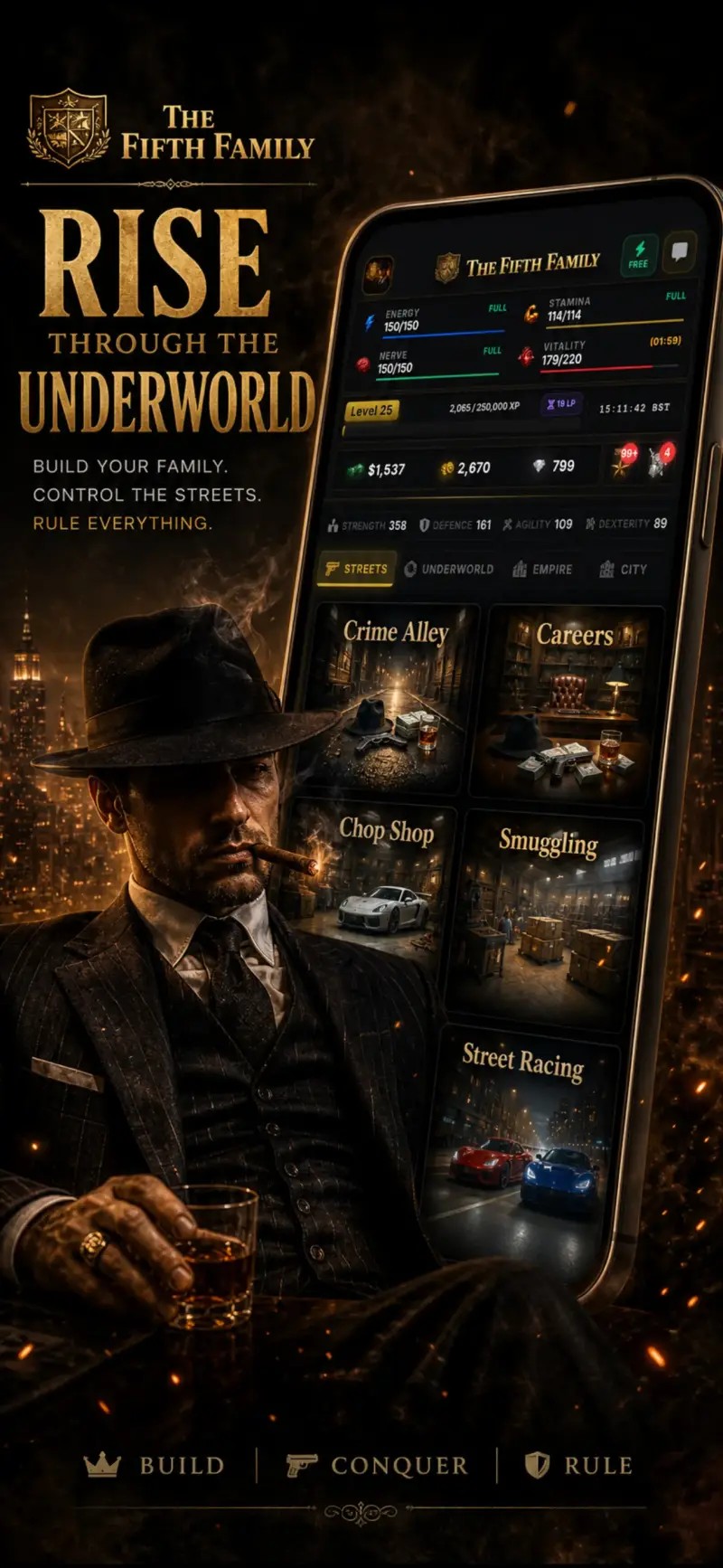
TFF combines crimes, careers, training, player families and a player-driven item market in a persistent criminal world. Rather than steering a hero across a fantasy map, you make decisions through activity screens, equipment and character stats. The crime reference, gym guide and family guide show how those systems work without requiring you to create an account first.
Consider it when: you want a mafia theme and a character you return to between other things. Skip it when: your priority is free movement, manual dodging or a fantasy quest map. Browser convenience does not make two very different combat systems interchangeable.
RPG MO: for fantasy skills, crafting and trade
RPG MO's official overview describes an open-world multiplayer RPG with combat and crafting paths, player trading and no required download. Its play page offers browser access alongside optional clients. This is the more relevant direction when gathering resources and making useful equipment matter more to you than the crime setting.
The trade-off is pace: the publisher explicitly describes higher-level progress as a long-term commitment. Choose the old-school skill-building loop because you enjoy it, not because you expect a browser game to finish quickly.
stein.world: for a visible fantasy world and active combat
stein.world describes a persistent 2D pixel world with quests, professions, crafting, trading and group dungeons. Its combat requires active attacks and dodging. That gives it a different appeal from a menu-driven crime RPG, even though both can run in a browser.
Consider it for fantasy exploration and direct control. It is less suitable for a player who wants every action to fit into a few seconds between other tasks. Browser compatibility also does not guarantee the same control comfort on every phone; try the current controls on your own device.
Torn: for text-based criminal character development
Torn is a text-based online crime RPG. Its official registration page describes free access and no scheduled character resets. This is a better match for someone seeking long-term account progression than for someone seeking real-time movement through a 3D world.
Compare it with TFF on the systems and presentation you prefer, not a promise that a newer game will let you catch every established player. Our Torn alternatives guide focuses on that decision.
Gangster Nation: for a competitive round rather than endless accumulation
Gangster Nation's official FAQ confirms browser and mobile access. Its rounds page explains that the playing field resets between rounds. That is the key reason to consider it: starting conditions can matter as much as the list of criminal activities.
A reset can be appealing when you want another competitive start. It is a drawback when the part you enjoy most is keeping years of accumulated progression. Read the round rules before treating it as a substitute for a no-reset world.
Hordes.io: for large-scale faction PvP with no preamble
Hordes.io runs as a single HTML5 tab and drops you into open-world faction warfare almost immediately. You pick a class, pick a side, and fight over territory alongside hundreds of other players in real time. There is no tutorial and very little onboarding, which is either the appeal or the problem depending on the player. Progression is gear and level driven rather than narrative, and the whole thing loads in seconds.
Consider it when: you want real-time group PvP and you would rather be thrown in than walked through. Skip it when: you want a story, a quest chain, or any structured explanation of what you are supposed to be doing.
Mirage Online Classic: for retro 2D depth with nothing to buy
A 2D browser MMORPG built in HTML5 with eleven character classes, dungeons, guilds, open-world PvP and trade skills. Its distinguishing feature is the monetisation model: the developers state there is no shop of any kind, cosmetic or otherwise. For a genre where "free to play" usually means something narrower, that is unusual enough to be the main reason to try it.
Consider it when: you want class variety and dungeon content, and you are tired of evaluating whether a game's shop is fair. Skip it when: retro 2D sprite work puts you off, or you want combat you steer directly rather than through targeting.
Outwar: for a long-running raid and ranking loop
Outwar has been running in browsers since 2002, which makes it one of the oldest continuously operating games in this category. The loop is quests, raiding bosses with a crew, and climbing rankings against other players. Two decades of accumulated systems means considerable depth, and also an interface that assumes you already know what you are looking at.
Consider it when: longevity matters to you and you want a game whose economy and community have had time to settle. Skip it when: you want a modern interface or a gentle first hour.
Titans of Time: for 3D in a browser tab
A free-to-play 3D browser MMORPG set across ancient realms and temples, with quest content as the main progression driver. The draw is straightforward: genuine 3D rendering with no client download, which remains uncommon in this category. Expect the performance trade-offs that come with running 3D through a browser.
Consider it when: you specifically want 3D visuals without installing anything. Skip it when: you are on older hardware, a Chromebook, or a connection where a heavier client-side render will struggle.
Realm of the Mad God: for permadeath and bullet-hell combat
A co-op shooter-MMO hybrid played from a top-down view, where combat is dodging patterns of projectiles rather than trading targeted attacks. Characters are permanently lost on death, so every run carries real weight and every piece of gear is temporary by design. It is the highest-intensity game on this list and the one least like the rest.
Consider it when: you want active, reflex-driven combat and you find permanence more interesting than accumulation. Skip it when: losing a character you invested in would make you stop playing. That is not a criticism of you; it is simply the wrong game for that temperament.
Fallen Sword: for a classic text-and-icon MMO that is still alive
Fallen Sword is among the best surviving examples of the text-and-icon MMO format that dominated browser gaming before HTML5 - a large world map with hundreds of areas, guilds, and a social layer that has held together over years rather than months. Progression is incremental and the interface is functional rather than polished.
Consider it when: you played this style of game a decade ago and want to know whether anything comparable still exists. Skip it when: you want visual spectacle or active combat.
Shakes & Fidget: for progression that continues while you are away
An idle RPG with a complete loop underneath the automation - questing, gear upgrades, dungeons, guilds and arena combat - that advances whether or not you have the tab open. The tone is deliberately comic, which is either refreshing or grating and is worth five minutes of your time to find out which.
Consider it when: you want meaningful progress from a few short check-ins a day. Skip it when: you want your time investment and your progress to be directly proportional.
Drakensang Online: for the best-looking action combat in a browser
A Diablo-style action RPG with real-time combat, layered loot systems and co-operative dungeons, rendered at a visual standard well above most browser games. It plays as an action RPG first and an MMO second - the social systems exist but the core is clicking through encounters and improving gear.
Consider it when: you want isometric action combat and loot progression without a download. Skip it when: you want a persistent world you inhabit rather than a series of instances you clear.
AdventureQuest Worlds: for a guided fantasy MMO with a long content tail
A long-running 2D fantasy MMO with a heavily quest-led structure and a very large accumulated content library. It is one of the more structured entries here, which makes it a reasonable starting point for someone new to the genre who wants to be told where to go next.
Consider it when: you want a guided experience and a deep back catalogue of content. Skip it when: you prefer open-ended systems over a quest list.
Kingdom of Loathing: for writing that carries the whole game
A stick-figure comedy RPG that has run for over two decades on the strength of its writing. Mechanically it is a daily-turn game - you get a set allocation of actions, spend them, and return the next day - which makes it one of the lowest-commitment games here. Nothing about the presentation prepares you for how carefully built the systems underneath actually are.
Consider it when: you want something genuinely funny and you are happy with a daily-turn rhythm. Skip it when: you want graphics, or you want to play for three hours straight.
Free browser play: what to check before spending
A free account, a browser client and a fair competitive experience are three separate questions. Check what access is free, whether subscriptions or consumables are offered, what purchases change, and how losses or resets work. Do not use the absence of a download as a shortcut for judging monetisation.
The Fifth Family is free to play, with its core systems available without a purchase. Optional purchases include cosmetics, crates, alignment shard packs and time savers such as gym speedups. These purchases are not all cosmetic. The level-scaled casino profit cap limits casino income; it does not by itself establish the effect of every purchase on competitive play. Check the current in-game descriptions before spending.
A practical way to compare two games
Give each the same small trial: create a character, complete the introduction, inspect the player market or social screen, and return later to see what changes while you are away. Decide whether you enjoy the routine, whether the interface works on your actual device, and whether the progression rules match your available time. Those observations are more useful than an unsupported “best overall” badge.
See The Fifth Family before joining
These are our existing promotional images illustrating the interface, not an independent hands-on test. Example balances, levels and positions shown in the artwork are not promises of starting rewards. For current rules and system details, use the public game wiki.


Questions before you choose
Are all browser MMORPGs text-based?
No. Browser games include menu-driven text RPGs and graphical worlds. RPG MO and stein.world offer fantasy-world play; Torn and The Fifth Family emphasise criminal character progression.
Do I need to install The Fifth Family?
No. The browser version is available without an app install. The iOS and Android apps are optional ways to access the game.
Does browser access mean a game is offline?
No. These are online multiplayer games. A browser is the access method, not an offline mode.
Which should I choose for RuneScape-style skilling?
RPG MO is worth investigating for its gathering, crafting and combat skills. The Fifth Family is a crime RPG, not a replacement for a fantasy world or RuneScape itself.